

Strong RPG characters win the endgame by matching their stats, gear, and skills to a clear role instead of spreading points everywhere. You build that strength early. Every choice you make in the first ten hours shapes how your character performs in the last ten.
Most players lose endgame fights not because they lack skill, but because their character was never built for the fight in the first place. A tank with no sustain. A mage with no mana efficiency. A DPS build with the wrong damage type against armored bosses. These mistakes come from planning too late.
This guide breaks down exactly how to build a character that holds up when the difficulty spikes hardest. You’ll get practical steps you can apply in almost any RPG, whether you’re playing a single-player title, an MMO, or a tactical RPG.
Choose a Role Before You Choose a Build
Your build should follow your role, not the other way around. Decide early whether you want to tank damage, deal damage, support your team, or control the battlefield. This single decision filters out 80% of bad stat choices.
Optimizing Your Role & Skill Progression
A character without a defined role inevitably becomes mediocre at everything, and endgame content ruthlessly punishes generalists. As bosses hit harder, elemental resistances stack, and encounter mechanics tighten, success demands dedicated specialists rather than Jack-of-all-trades builds. While optimizing your primary attributes lays the foundation, true combat efficiency hinges on how meticulously you structure your active and passive nodes. To break through DPS ceilings and transform individual skill points into compounding offensive power, explore our dedicated breakdown on build the best skill trees for maximum damage to master high-tier synergies, refine pathing, and unlock your character’s ultimate potential.
Common RPG Roles and What They Need
- Tank: High defense, health, and threat generation. Needs damage mitigation skills over raw damage output.
- DPS (Damage Dealer): Focused stat investment in one damage type. Needs consistent output, not burst that falls off late-game.
- Support/Healer: Resource management and utility. Needs mana or energy efficiency more than raw power.
- Control: Crowd control effects and battlefield management. Needs duration and resistance-piercing over damage.
Pick one. You can always respec later in games that allow it, but starting with a clear role saves you from wasted stat points.
Prioritize Stats That Scale, Not Stats That Feel Good Early
Some stats feel powerful at level 10 and become useless at level 60. Strong endgame characters invest in stats that scale with difficulty, not stats that only help against weak early enemies.
Flat damage bonuses often lose value as enemy health pools grow. Percentage-based bonuses, critical hit chance, and stats that interact with your gear’s scaling systems tend to hold their value much longer. Before you dump points into a stat, check whether it’s a flat number or a percentage modifier. Percentage modifiers almost always age better.
How to Check If a Stat Scales Well
Look at how the stat’s tooltip describes its effect. If it says “+15 damage,” that’s flat and will lose relative value. If it says “+15% damage” or “+15% critical chance,” it scales with your other gear and stays relevant.
Avoid Overinvesting in Utility Stats Early
Movement speed, minor resistances, and small quality-of-life stats matter less than people think. Save heavy investment in these for after your core damage or survival stats are solid.
Build Gear Sets Around Synergy, Not Just Raw Power
Gear that works together beats gear with the highest individual numbers. A full set built around one theme, like critical hits or elemental damage, usually outperforms a mismatched collection of “best in slot” items.
Many RPGs include set bonuses that unlock extra effects when you wear multiple pieces from the same collection. These bonuses often add more effective power than swapping one item for a slightly higher number elsewhere. Before you chase a single powerful item, check whether completing a weaker set gives you more total value.
Questions to Ask Before Equipping New Gear
- Does this item support my chosen role, or does it pull me toward a different playstyle?
- Does it complete or break a set bonus I already have?
- Does the stat distribution match what scales well at my current level?
A Genuinely Useful Insight Most Guides Skip
Many players chase the newest drop the moment they get it, assuming new always means better. It doesn’t. A lower-level item with perfect synergy for your build frequently outperforms a higher-level item with random stats. Before replacing gear, compare the full stat sheet, not just the item level number. This one habit separates strong endgame builds from mediocre ones far more than any single stat choice does.
Balance Offense and Defense for Long Fights
Endgame bosses take longer to kill than early enemies, which means your character needs to survive extended encounters, not just deal quick burst damage. A build that wins in five seconds against weak enemies often collapses in a five-minute boss fight.
Glass cannon builds work well against content that dies fast. They fail against content with high health pools and hard-hitting attacks. If your build has zero defensive stats, test it against a long fight before committing further points. You’ll quickly see whether you can survive long enough to use your damage.
Simple Defense Checklist
- Can you survive three consecutive hits from a boss-level enemy at your current gear?
- Do you have a sustain option, whether healing, shielding, or lifesteal?
- Can you avoid or reduce incoming damage through positioning or defensive skills?
If you answer no to any of these, your build needs adjustment before you push into harder content.
Plan Your Skill Tree Around Your Endgame Playstyle
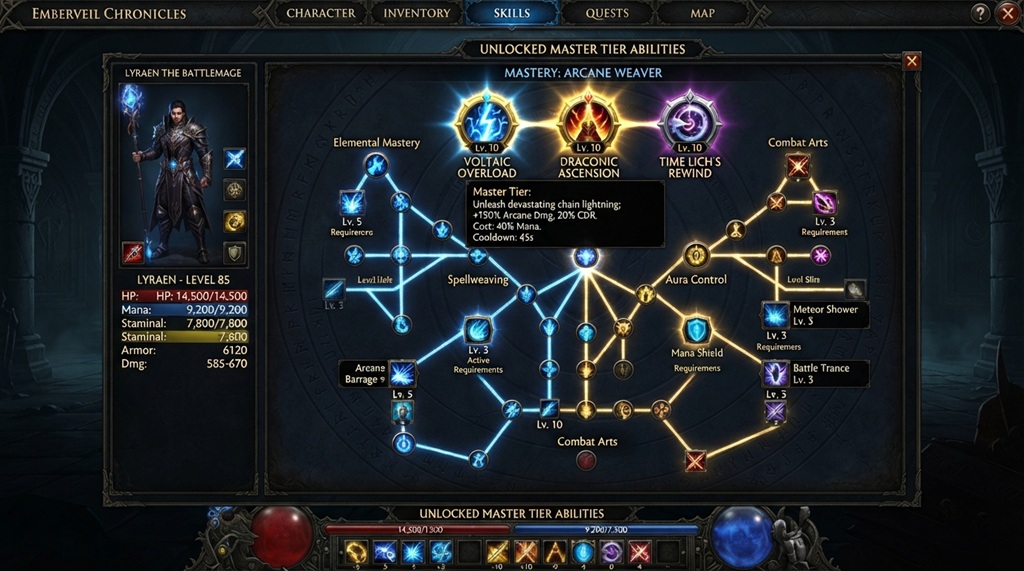
Skill points spent early should still make sense at max level. Before investing, imagine the hardest fight in the game and ask whether this skill helps you survive or win it. Skills that only help against weak, early-game enemies waste points you’ll need later.
Core Skills vs. Situational Skills
Core skills form the backbone of your build and get used in nearly every fight. Situational skills only shine in specific scenarios. Strong endgame characters max their core skills first and treat situational skills as optional extras once the essentials are covered.
Respeccing: When It’s Worth It
If your game allows respeccing, don’t be afraid to use it once you understand your role better. A build made with full endgame knowledge almost always beats one made blindly at level one. Many strong players respec at least once between the early game and the endgame push.
Test Your Build Against Real Endgame Content Before Committing
Theorycrafting only gets you so far. The real test happens in actual endgame content, where numbers on paper meet real enemy behavior. Run your build through a mid-tier endgame challenge before fully committing resources to it.
Watch for specific failure points: Do you run out of resources mid-fight? Do you die to mechanics your build can’t handle? Does your damage output feel too slow against tankier enemies? These signals tell you exactly where to adjust before you invest more time and materials into a build that might not hold up.
Frequently Asked Questions
What’s the biggest mistake players make when building RPG characters for the endgame?
The most common mistake is spreading stat points across too many attributes instead of committing to one clear role. This creates a character that’s mediocre at everything and excellent at nothing, which fails against specialized endgame content.
Should I focus on gear or skills first when building for the endgame?
Skills should come first because they define how your character functions in combat. Gear then amplifies whatever playstyle your skills create, so building skills without a plan wastes the gear you’ll collect later.
How often should I change my build in an RPG?
Change your build whenever new content clearly punishes your current setup, or when you unlock gear or skills that meaningfully outperform what you have. Constant changes waste resources, but staying rigid when your build clearly underperforms costs you more in the long run.
Do stat caps matter when building strong endgame characters?
Yes, many RPGs have diminishing returns or hard caps on certain stats. Check whether a stat has a soft cap before overinvesting, since points beyond that cap often provide little to no additional benefit.
Is it better to specialize in one damage type or stay flexible?
Specializing usually wins in the endgame because most late-game gear and skill bonuses reward focused investment. Staying flexible works early on, but it typically weakens your character once enemies demand consistent, high-output damage against specific resistances.
Conclusion
Building a strong RPG character for the endgame comes down to five habits: pick a role early, invest in stats that scale, build gear around synergy, balance offense with defense, and test your build against real content before you commit fully. Players who follow this process consistently outperform those who chase random power spikes without a plan.
Start with your role, build outward from there, and adjust based on what actual endgame fights teach you. That approach beats guesswork every time.


