

Unbiased game reviews exist, but you have to know where to look. Most review sites mix genuine opinions with paid promotions, early-access perks, and publisher pressure. This guide shows you how to separate honest reviews from marketing disguised as journalism.
Gamers lose money every year on titles that looked amazing in reviews but felt disappointing at launch. That gap often comes down to bias, not bad luck. Once you learn the warning signs, you can spot them in seconds.
This article breaks down the exact steps you can take before your next purchase. You’ll learn which sources to trust, which red flags to avoid, and how to build your own quick-check system.
Why Game Reviews Are Often Biased
Game reviews get biased when money, access, or relationships influence the writer’s opinion. Publishers send free copies to outlets. They also offer early access, exclusive interviews, and ad placements. These perks can quietly shape how a reviewer talks about a game, even without a formal agreement.
Common Sources of Bias
- Advertising relationships. A site that runs ads for a publisher may soften criticism of that publisher’s games.
- Early access embargoes. Reviewers who get early builds sometimes feel pressure to publish positive coverage to keep that access.
- Affiliate links. Some sites earn commission when you click “buy now,” which can nudge reviews toward recommending a purchase.
- Personal bias toward genres. A reviewer who loves shooters may rate a mediocre shooter higher than a strategy fan would.
None of this means every review is fake. It means you need context before you trust a score.
How to Spot a Sponsored or Paid Review
You can usually spot a sponsored review by checking for disclosure statements, vague criticism, and unusually fast praise. Most legitimate outlets label sponsored content clearly, often at the top or bottom of the article. Look for phrases like “in partnership with” or “sponsored by.”
Signs a Review May Be Paid or Influenced
- No disclosure at all. Reputable sites disclose free copies or sponsorships. Silence on this point is a warning sign.
- Reviews published on day one. A 40-hour RPG reviewed within hours of launch likely wasn’t fully played.
- Praise without specifics. Vague lines like “this game is amazing” without gameplay details often signal low effort or influence.
- Missing negatives entirely. Every game has trade-offs. A flawless score with zero criticism deserves a second look.
If a review checks two or more of these boxes, treat the score as marketing, not analysis.
Reliable Sources for Honest Gaming Critiques
Finding genuinely unbiased game reviews requires looking past promotional hype to independent voices specifically user-review aggregators, self-funded long-form video essayists, and neutral critics who purchase their own media. Platforms like OpenCritic and Metacritic aggregate scores across hundreds of outlets to effectively neutralize individual bias, offering a balanced consensus before you invest. Master these evaluation strategies, then discover choose the right game worth your money to consistently maximize your entertainment budget.
Reliable Review Sources
- Aggregator sites. OpenCritic and Metacritic show a spread of scores, so you can see where critics disagree.
- User review sections. Steam and other storefronts show real player feedback, though these can include review-bombing during controversies.
- Independent YouTube and Twitch creators. Smaller creators who buy their own games often have less financial pressure than large outlets.
- Reddit communities. Subreddits dedicated to specific genres often surface honest, detailed impressions from actual players.
No single source is perfect. Cross-checking two or three sources gives you a more accurate picture than relying on one score.
How to Read a Review Critically (Even From Trusted Sites)
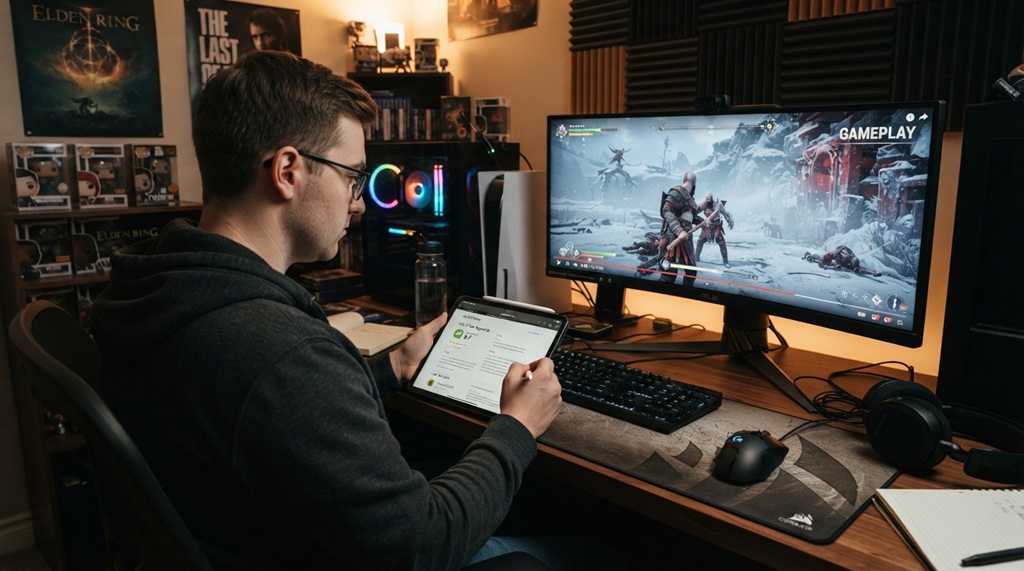
You should read the full review, not just the score, and pay attention to what the reviewer values most. A 7/10 from a critic who prioritizes story might mean something different than a 7/10 from a critic focused on multiplayer balance.
A Quick Checklist While Reading
- Check the reviewer’s playtime. Reviews that mention hours played, not just “I finished it,” tend to carry more weight.
- Look for specific examples. Good reviews mention actual mechanics, missions, or bugs, not just general impressions.
- Compare the pros and cons list. If the cons list feels thin or generic, the review may not be fully honest.
- Read the comments section. Other readers often point out inconsistencies or missing context the reviewer left out.
This approach takes a few extra minutes, but it saves you from buying a game based on hype alone.
The Role of Review Bombing and Astroturfing
Review bombing happens when large groups leave extremely low scores for reasons unrelated to gameplay, such as controversies or price changes. Astroturfing is the opposite problem: coordinated fake positive reviews meant to boost a game’s score artificially.
Both distort the picture you’re trying to get. A sudden spike of 1-star reviews right after a controversy, or a flood of 5-star reviews the same week a game launches with no real detail, should raise questions.
How to Handle These Situations
- Check the review dates. A cluster of extreme reviews on one specific day often points to an external event, not gameplay quality.
- Read a handful of the actual reviews, not just the score. Genuine complaints usually mention specific mechanics or bugs.
- Wait a week or two after launch if a game seems caught in controversy. Scores often settle once initial reactions calm down.
This step matters most for big-budget releases, where public reaction can move faster than the actual game content.
An Underused Trick: Compare Review Language, Not Just Scores
Most guides tell you to check scores and disclosures. Fewer mention this: compare the actual wording across three or four reviews of the same game. If multiple outlets use nearly identical phrases, such as the same buzzwords or the same list of “best moments,” it often means they received a shared press kit or embargoed talking points from the publisher.
Genuinely independent reviews tend to describe the same game in different ways, because each reviewer noticed different details. When you see matching language across outlets, that’s a stronger bias signal than a missing disclosure statement, because it shows the marketing narrative shaping the coverage, not just the writer’s access.
This trick takes a few extra minutes, but it works even on well-known, reputable sites that would never publish a technically “sponsored” post.
Frequently Asked Questions
Are Metacritic scores reliable?
Metacritic scores are a useful starting point, not a final answer. They combine many critic reviews into one number, but they don’t account for bias within individual reviews, so you should still read a few of the underlying reviews yourself.
Why do user reviews and critic reviews often disagree?
User reviews and critic reviews often disagree because players and professional reviewers value different things. Critics may prioritize technical polish and story structure, while players often weigh price, replay value, and community reception more heavily.
Is it safe to trust a game’s review score on launch day?
Launch-day scores can be unreliable, especially for long or complex games. Reviewers may not have finished the full game yet, so waiting a few days for follow-up reviews or player feedback often gives a more accurate picture.
Do YouTube reviewers get paid to promote games?
Some YouTube reviewers do receive payment or free copies, and by law they’re required to disclose this in the video description or verbally. Check the description box and the first minute of the video for any sponsorship disclosure before trusting the opinion fully.
What’s the fastest way to check if a review is trustworthy?
The fastest check is looking for a disclosure statement, specific gameplay details, and a mix of pros and cons. If a review has none of these, treat it as marketing rather than an honest evaluation.
Conclusion
Unbiased game reviews are out there, but they rarely come from a single source. Cross-check aggregator scores, read full reviews instead of just headlines, and watch for matching language across outlets. That last step, comparing wording rather than just scores, catches bias that most guides miss entirely.
Spend a few extra minutes before you buy. It’s a small habit that protects both your money and your time.