
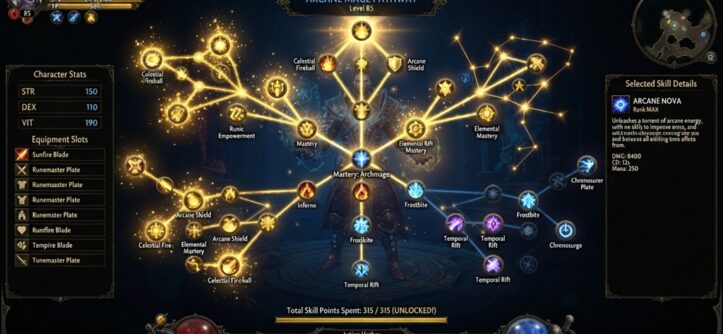
Building the best skill trees for maximum damage comes down to three things: prioritizing damage multipliers first, avoiding wasted points on utility nodes, and stacking synergies that compound rather than just add up. Get these three right, and your damage output jumps far more than random point spending ever could. Get them wrong, and you end up with a “spread thin” build that feels weak in every fight.
Most players build skill trees the wrong way. They grab whatever node looks flashy, or they follow a build guide without understanding why it works. This guide breaks down the actual logic behind high-damage skill trees, so you can build one for any game and adapt it as patches or new content roll out.
Whether you’re optimizing a build in an RPG, an action game, or a looter-shooter, the core principles stay the same. Let’s get into exactly how to apply them.
Understand the Difference Between Flat Damage and Multiplicative Damage

Flat damage adds a fixed number to your hits. Multiplicative damage increases your total output by a percentage. This distinction matters more than almost anything else when building a skill tree.
A flat damage node might say “+10 damage.” A multiplicative node might say “+15% damage.” Early on, flat damage feels stronger because your base numbers are small. But as your build scales, multiplicative nodes pull far ahead, because they apply to your entire damage output, not just a single hit.
Why This Matters for Point Allocation
Skip flat damage nodes once you have any multiplicative options available. Industry experts on build optimization generally agree that percentage-based scaling nodes should be prioritized in the mid-to-late game, since their value compounds with every other damage source you add later.
A simple rule: if a node says “increased damage” or gives a percentage, it usually outperforms a node that adds a static number, once your build has more than one damage source active.
Prioritize Nodes That Affect Your Main Damage Source First
Your skill tree should follow your primary damage source, not spread evenly across every option. Identify whether your build leans on a specific weapon type, a spell school, a summon, or a melee combo, and put your first 60-70% of points into nodes that boost that exact source.
Spreading points across multiple damage types dilutes your build. A hybrid build that does 20% more fire damage and 20% more physical damage often ends up weaker than a focused build that does 50% more fire damage alone, because most games apply bonuses per damage type rather than universally.
Pinpointing Your Primary Damage Driver
To build an optimal character, first analyze which ability or weapon accounts for at least 70% of your actual combat output over recent play sessions this core mechanic is your primary damage driver and demands your initial, fully maxed skill investment before you diversify into secondary trees. Once this foundational path is fully optimized, you can seamlessly accelerate your overall progression by incorporating strategies on how to level up fast in RPGs and unlock rare gear to secure the prerequisite skill points and high-tier equipment needed to maximize your build’s potential.
Common Mistake: Chasing Every Shiny Node
New players often grab nodes because they look powerful, not because they support the build. A node that boosts critical hit chance is useless if your build rarely lands crits. Always ask: “Does this node support what my character actually does in combat?” before spending a point.
Stack Synergies Instead of Isolated Bonuses
Synergy stacking means choosing nodes that interact with each other, not just nodes that each add a small bonus on their own. This is the “genuinely useful” trick most damage guides skip entirely, because it takes more thought than just listing “best nodes.”
Here’s a practical example. A node that increases critical damage does nothing on its own if your crit chance is low. But pair it with a node that raises crit chance, and now every crit hits significantly harder. Neither node alone is impressive. Together, they multiply your damage in a way flat bonuses never will.
Look for These Synergy Patterns
- Chance + magnitude pairs: crit chance nodes paired with crit damage nodes
- Trigger + payoff pairs: nodes that cause an effect (like burning or bleeding) paired with nodes that boost damage from that specific effect
- Resource + spender pairs: nodes that generate a resource faster paired with nodes that make spending that resource hit harder
When you plan a skill tree, map out these pairs before you spend a single point. A build with three strong synergy pairs will usually outdamage a build with fifteen scattered bonuses.
Don’t Neglect Survivability Nodes Entirely
A pure glass-cannon build sounds appealing, but zero defensive investment often lowers your actual damage output over time. Dead characters deal no damage. A build that dies every third fight and spends time respawning or retreating puts out less total damage than a slightly tankier build that stays in the fight longer.
This doesn’t mean you should split your tree 50/50 between offense and defense. A small investment, often 10-15% of your total points, in health, damage reduction, or sustain nodes usually pays for itself. It keeps you alive long enough to use your full damage rotation instead of dying mid-combo.
Where to Cut Corners Safely
If you need points for survivability, pull them from late-tree damage nodes with small returns, not from your core synergy pairs. Late-tree nodes often give diminishing returns anyway, so this trade rarely costs you much actual damage.
Adjust Your Skill Tree for Different Content Types

The best skill tree for boss fights isn’t always the best skill tree for clearing groups of weaker enemies. Many games let you respec, so build a primary damage-focused tree and adjust smaller sections depending on what you’re facing.
Single-target content, like boss fights, rewards sustained damage nodes and crit synergy pairs. Group content, like clearing waves of enemies, rewards area-of-effect nodes and damage-on-hit effects that spread across multiple targets. If your game allows cheap or free respecs, keep two loadouts in mind rather than trying to force one tree to do everything well.
Signs You Need to Respec
- Fights against single tough enemies take noticeably longer than they should
- You struggle to clear groups even though your single-target damage feels strong
- A recent patch changed how one of your core nodes scales
Review and Adjust Your Build Regularly
Skill trees aren’t a “set it and forget it” system, especially in live-service games. Developers frequently patch damage numbers, and a node that was strong last season might get nerfed into irrelevance. Check patch notes before committing heavily to any single node, especially ones with unusually high damage numbers, since those are common nerf targets.
Community build guides and forums update faster than most in-game tutorials. Cross-check your build against recent, updated guides rather than older ones, since a guide from before a major patch may recommend nodes that no longer perform the same way.
Frequently Asked Questions
Should I focus on one damage type or spread across multiple?
Focus on one primary damage type first. Most games apply damage bonuses per type, so splitting your points across fire, physical, and elemental damage usually results in weaker overall output than committing fully to one type and its synergy nodes.
How many points should go into defense versus offense?
A general guideline is 10-15% of your total points into survivability, with the rest going toward your core damage path. This ratio can shift slightly depending on the difficulty of the content you’re tackling, but pure offense builds usually underperform once fights get harder.
Is it worth respeccing for different content types?
Yes, if your game allows cheap or free respecs. Single-target content and group-clear content often reward different node choices, so a flexible build usually outperforms one rigid tree trying to handle everything.
What’s the biggest mistake players make when building skill trees?
The biggest mistake is grabbing flashy-looking nodes instead of nodes that support their main damage source. A node that boosts crit chance is wasted on a build that rarely crits, no matter how strong the node looks on paper.
How often should I update my skill tree?
Check your build after every major patch, since damage numbers and node scaling change often in updated games. A build that was optimal last month might need adjusting once developers rebalance specific nodes or damage types.
Conclusion
Building the best skill tree for maximum damage isn’t about grabbing every strong-looking node. It’s about prioritizing your main damage source, stacking synergy pairs that multiply rather than add, keeping just enough survivability to stay in the fight, and adjusting your build as content and patches change. Follow these principles, and your skill tree will consistently outperform builds put together through guesswork alone.


