

Civilization VII is one of the biggest strategy games to hit shelves in years. Released on February 11, 2025, by Firaxis Games and published by 2K, it is available on PC, PlayStation 5, PlayStation 4, Xbox Series X and S, Xbox One, and Nintendo Switch. US players have embraced it enthusiastically, but many find the early hours overwhelming. The game introduces new systems that even veterans of the series need time to understand.
This guide is here to help. Whether you are picking up a Civilization game for the first time or returning after years away, you will find clear, practical advice to get your empire moving in the right direction.
Why Civilization VII Feels Different from Earlier Games
Civilization VII makes some bold changes to the classic formula. The most notable is the separation of leaders from civilizations. In past games, you chose one and got the other automatically. Now, you pick them independently. This opens up a wide range of strategic combinations, but it can feel confusing at first.
The game is also structured around Ages. You progress through the Antiquity Age, the Exploration Age, and the Modern Age. Each transition brings significant changes to your civilization. Additionally, the distinction between Cities and Towns adds a layer of economic decision-making that earlier games did not include.
However, do not let these new systems intimidate you. Once you understand the basics, they make the game richer and more rewarding than ever.
Best Starting Settings for New US Players
Your first game sets the tone for everything that follows. Choosing the right settings gives you room to learn without constantly losing ground to aggressive opponents.
| Setting | Recommended Choice | Why It Helps |
| Difficulty | Scribe | Forgiving enough to learn without constant punishment |
| Map Type | Continents Plus | Gives you ocean borders and land neighbors to balance exploration |
| Map Size | Small | Fewer civilizations means less chaos early on |
| Game Speed | Standard | Balanced pacing for learning all systems |
| Starting Age | Antiquity | Builds your empire from the ground up, step by step |
These settings give you the most comfortable learning environment. Once you feel confident, you can raise the difficulty and experiment with larger maps.
Choosing Your Leader and Civilization
For your first run, the official recommendation from the developers at 2K is to play as Hatshepsut leading Egypt. Hatshepsut suits beginners well because her strengths are built around navigable rivers and steady economic growth. This kind of start forgives mistakes and gives you time to learn the systems at your own pace.
Rome is another excellent choice for beginners. Its unique bonuses generate extra culture from your capital and towns, which keeps your civics research moving forward. Rome also provides free infantry units in new settlements, making early expansion significantly easier.
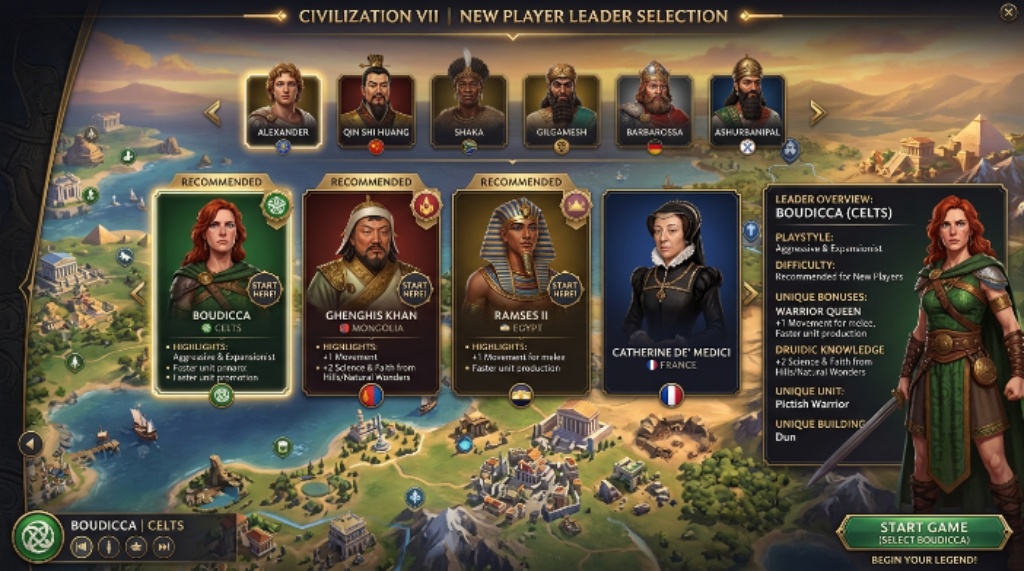
Here is a quick comparison to help you decide:
| Leader / Civilization | Best For | Key Strength |
| Hatshepsut / Egypt | Economic learners | River-based growth and stability |
| Rome | Expansion-focused players | Culture bonuses and free military units |
| Benjamin Franklin | US-themed roleplay runs | Science and trade advantages |
Mix and match once you are comfortable. The game is designed to reward creative combinations across different leaders and civilizations.
Your First Turns: What to Do Right Away
The opening turns of any Civilization game are the most important. The decisions you make in the first thirty to fifty turns shape your entire early game. Therefore, follow these priorities from the very start.
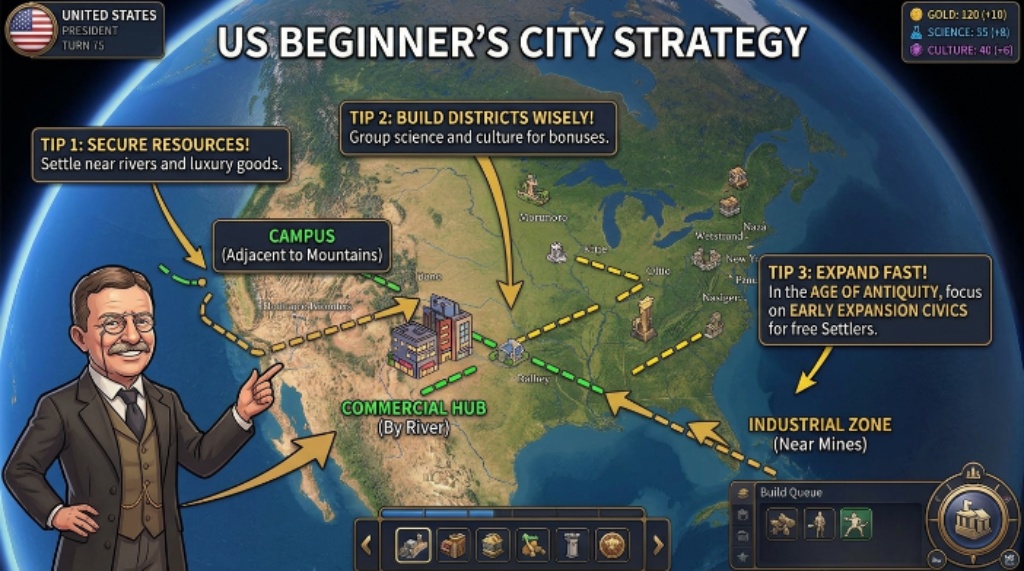
Place your capital near fresh water and resources. Rivers provide housing bonuses and improve growth. Resources nearby give your early buildings something to work with from the beginning.
Train scouts early. Exploration is critical in Civilization VII. The game removed the auto-scout feature from the previous installment, so you need to guide your scouts manually. Send them outward in different directions to reveal ruins, natural wonders, and good land for future settlements.
Once your capital reaches a population of five, start building a settler. Founding a second city early is one of the best moves you can make. More cities mean more production, more science, and more income flowing into your empire.
Understanding Ages and How to Prepare for Transitions
The Age system is one of the most important new features in Civilization VII. Each Age has its own set of technologies, civics, and legacy paths. When an Age ends, your civilization changes significantly.
The key is to plan for the transition before it arrives. Do not ignore the legacy path goals for each Age. These goals reward you with powerful bonuses that carry into the next Age. Think of them as a checklist that shapes your long-term strategy.
Additionally, make sure your economy is stable before any transition. The shift between Ages can feel disruptive if your production and income are not on solid ground.
Cities vs. Towns: A Simple Explanation
This is one of the systems that confuses new players the most. Here is a straightforward way to think about it.
Cities are your main production hubs. They have full access to the production queue and can build districts, wonders, and military units. Invest your resources here.
Towns support your economy in a different way. They do not use a standard production menu at first. Instead, they generate income, food, and other yields that flow back to your empire. Towns can eventually be upgraded into full cities, but doing so costs resources.
The common mistake beginners make is trying to upgrade every town into a city too quickly. Resist that temptation. A strong network of towns supporting a few powerful cities is far more effective than spreading your resources too thin.
Early Military and Defense Tips
You do not need a massive army in the early game. However, leaving your capital completely undefended is a serious mistake. One or two military units near your capital are usually enough to deter early aggression from neighboring civilizations.
Scouts serve an additional purpose beyond exploration. They can spot incoming threats and give you time to respond. Keep at least one scout active throughout the Antiquity Age.
When conflict does arise, use terrain to your advantage. Units gain defensive bonuses on hills and inside forests. Position your defenders wisely rather than fighting in open ground where attackers have an equal footing.
Do not rush into early wars unless you have a clear military advantage. Conflict drains production and gold at a stage when your empire needs both to grow.
Diplomacy and Influence: Do Not Ignore Them
Many new players focus entirely on military and science while ignoring diplomacy. That is a costly oversight. Diplomatic relationships shape how other civilizations treat you throughout the entire game.
Sending envoys and building influence with city-states gives you access to powerful bonuses. Some city-states provide science boosts, others offer gold or military support. Prioritize city-states that complement your chosen victory path.
Trade routes are another tool that new players underuse. Establishing trade routes between your cities and foreign capitals generates gold and sometimes science or culture. Therefore, build your first market as early as your production allows.
Choosing a Victory Path That Suits You
Civilization VII offers multiple ways to win. Picking one early and building toward it makes your decisions much clearer throughout the game.
| Victory Type | How to Pursue It | Best For |
| Science | Build campuses, research techs quickly, reach space milestones | Players who love long-term planning |
| Culture | Generate culture, attract tourists, fill civics tree fast | Creative players who enjoy storytelling |
| Military | Build strong armies, conquer rival capitals | Aggressive, direct playstyles |
| Economic | Accumulate gold, dominate trade routes | Patient players who prefer steady growth |
For beginners, the economic or culture path tends to be the most forgiving. These paths allow you to grow at your own pace without requiring constant military engagement.
Common Beginner Mistakes and How to Avoid Them
Learning from mistakes is part of the Civilization experience. However, knowing what to avoid ahead of time saves a lot of frustration.
- Founding too many settlements too quickly stretches your resources and slows everything down
- Ignoring the legacy path goals for each Age means missing out on crucial long-term bonuses
- Building every available option in your cities wastes production on things that do not support your victory path
- Neglecting science and culture while chasing military power leaves your civilization falling behind in the later Ages
- Forgetting to explore early means missing ruins, natural wonders, and prime settlement locations
Additionally, do not be afraid to pause and read the tooltips. Civilization VII includes a detailed advisor system that explains mechanics as they appear. Use it freely, especially in your first game.
Conclusion
Civilization VII rewards patience, curiosity, and long-term thinking. For US players jumping in for the first time, the most important steps are starting on Scribe difficulty, picking a beginner-friendly leader like Hatshepsut or Rome, exploring early, and planning for Age transitions before they arrive. Keep your cities focused, your towns productive, and your diplomacy active. Avoid spreading too thin, and choose a victory path that matches your preferred playstyle. The learning curve is real, but every game teaches you something new. With the right foundation, you will be building powerful empires and competing on higher difficulties before you know it.
Frequently Asked Questions
What is the best difficulty setting for new players in Civilization VII?
Scribe difficulty is the recommended starting point. It gives you enough of a challenge to stay engaged while being forgiving enough to let you learn the game’s systems without constant setbacks.
Should I choose Rome or Egypt for my first game?
Both are excellent beginner choices. Egypt under Hatshepsut is ideal for economic and peaceful playstyles centered on rivers. Rome suits players who want to expand aggressively and benefit from strong cultural bonuses. Try both and see which style fits you better.
What is the Age system in Civilization VII?
The game is divided into three Ages: Antiquity, Exploration, and Modern. Each Age has its own technologies, civics, and goals. Completing legacy path goals before each Age transition rewards you with powerful bonuses that carry forward into the next era.
What is the difference between a City and a Town?
Cities are full production hubs where you build districts, wonders, and units. Towns generate economic yields but do not have a standard production queue at first. Towns can be upgraded to cities, but doing so costs resources and should be done strategically rather than automatically.
Is Civilization VII available on consoles in the US?
Yes. Civilization VII is available in the US on PlayStation 5, PlayStation 4, Xbox Series X, Xbox Series S, Xbox One, Nintendo Switch, and PC. All versions support the same core gameplay experience.