

Drifting well comes down to three things: braking at the right moment, steering into the slide, and controlling your throttle through the corner. Master those three, and you’ll take corners faster than opponents who just brake and turn. This guide breaks each skill down into steps you can practice right now.
Most players lose races not because their car is weaker, but because they scrub speed in corners. A clean drift keeps your car moving fast through a turn instead of slowing down and speeding back up. That difference adds up over a full race.
Below, you’ll find the core techniques, common mistakes, game-specific tips, and a practice plan. Pick the section that matches where you’re stuck, or read straight through to build a complete skill set.
What Drifting Actually Does for Your Lap Times
Drifting lets you carry more speed through a corner than a normal turn allows. Instead of slowing down, turning, then accelerating, you keep your speed high and let the car slide sideways through the apex.
This matters because braking costs you time twice once when you slow down, and again when you have to build speed back up. A good drift skips that second cost. You stay on the throttle, the car rotates, and you exit the corner already at speed.
That said, drifting isn’t always faster than grip driving. In some games, especially sim-style racers, a clean grip line beats a drift every time. Arcade racers like Need for Speed or the Forza Horizon series reward drifting more directly, often with points, boost, or nitro built into the drift mechanic itself.
Core Universal Techniques of Racing Game Drifting
While handling physics varies across different titles, the fundamental mechanics of executing a flawless drift remain identical. Initiating the slide requires precise braking to shift the vehicle’s weight forward, followed by a sudden application of counter-steering to break traction cleanly at the apex. The true art, however, lies in balance; maintaining sustained drift angles demands subtle throttle modulation to balance rear-wheel spin with dynamic balance. Mastering throttle control not only improves cornering speeds, but it also teaches you to win racing tournaments and unlock fast cars early in the game. By mastering this foundational technique, you build a transferable skillset that seamlessly elevates your performance across arcade simulators and competitive racing titles alike.
Braking Before the Corner, Not During It
Brake before you turn, not while you’re mid-corner. Braking while turning shifts weight forward and makes your rear end grip instead of slide, which kills your drift before it starts.
Tap the brake just before the corner entry. This shifts weight to the front wheels and unweights the rear, which is exactly what you need to break traction.
Initiating the Slide
Turn into the corner slightly sharper than a normal racing line, then counter-steer as the back end swings out. This is the moment most beginners get wrong they either turn too little (no slide happens) or too much (they spin out).
A handbrake, clutch kick, or scheduled weight transfer can also trigger the slide, depending on the game and your controller setup. Console games often map a dedicated drift button; PC sims usually rely on throttle and steering alone.
Controlling the Slide with Throttle
Once you’re sliding, your throttle controls the angle of the drift, not your steering wheel. Ease off the gas and the car tightens up. Add more throttle and the car swings wider.
This is the skill that separates good drivers from great ones. You’re constantly making tiny throttle adjustments to hold the car at the exact angle you want through the whole corner.
Exiting Clean
Straighten your wheels as the corner opens up and get back on full throttle. A messy exit where you’re still sliding as the track straightens costs you speed and sometimes control entirely.
Common Mistakes That Ruin Your Drift
Most drifting problems trace back to a handful of repeated errors.
Turning Too Late
If you wait until you’re already at the corner to start your input, you won’t have time to set up the slide properly. Start your brake and steering input earlier than feels natural at first.
Overcorrecting with the Steering Wheel
New players often panic when the car starts to slide and yank the wheel the other way. This usually sends the car into a spin instead of a smooth drift. Small, steady corrections work better than big, sudden ones.
Using Full Throttle Too Early
Slamming the gas mid-drift breaks your control and can send the rear end out too far. Build throttle gradually as you feel the car settle into the slide.
Ignoring Your Racing Line
A perfect drift on the wrong line still costs you time. Your entry point, apex, and exit still need to follow a smart racing line drifting is a technique layered on top of that line, not a replacement for it.
Game-Specific Tips for Popular Racing Titles
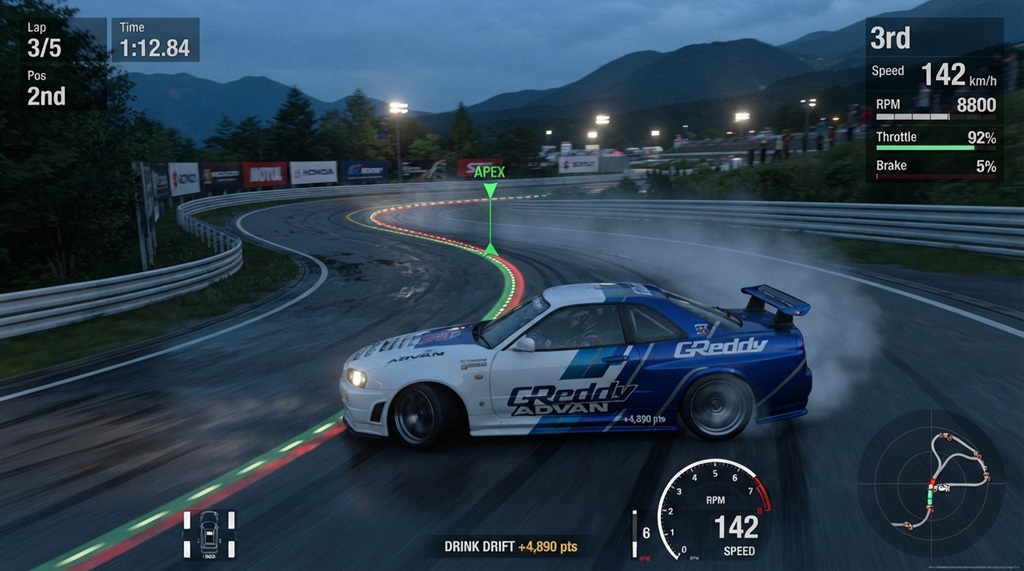
Different games reward different drift styles, so a technique that works in one title might hurt you in another.
Arcade Racers (Need for Speed, Forza Horizon)
These games are built around drifting and often reward it with nitro, points, or drift score multipliers. Hold your drift longer through wide corners to bank extra boost, and chain drifts through S-bends without fully straightening between them.
Sim Racers (Gran Turismo, Assetto Corsa, iRacing)
Sim-style games punish sloppy drifting with lost time, since grip driving is usually faster on a clean track. Save drifting for wet conditions, dirt sections, or hairpin turns where a controlled slide genuinely helps your line.
Mobile Racing Games
Touchscreen controls make fine throttle control harder, so many mobile racers use auto-drift or assisted steering. Lean on these assists first, then turn them off gradually as your timing improves.
Controller and Setup Adjustments That Help
Your hardware and in-game settings shape how forgiving or twitchy your drifts feel.
Lower your steering sensitivity slightly if you’re overcorrecting often a wheel or stick that reacts less aggressively gives you more room to make small adjustments. If your game offers a manual handbrake, bind it to a button you can hit instantly without looking down, since timing matters more than force here.
Traction control settings also change everything. Turning traction control off gives you full control over your slides but punishes mistakes harder. Keep it on low if you’re still learning, then switch it off once your throttle control feels consistent.
A Simple Practice Plan to Build Drift Skill Fast
Skipping straight to race mode makes it hard to isolate what’s going wrong. A focused practice routine fixes that.
Start in a free-roam or practice mode with no other cars on track. This removes the pressure of racing and lets you repeat the same corner until the drift feels natural. Pick one single corner and drift it 15–20 times in a row, focusing only on your brake timing.
Once brake timing feels automatic, add steering input as the second variable. Then layer in throttle control as the third. Trying to fix all three at once usually leads to frustration one variable at a time works better.
Finally, take your practiced corner into an actual race and see how it holds up under pressure from other cars. Skills that feel solid in an empty track often need a few races to become second nature under real conditions.
Frequently Asked Questions
Is drifting always the fastest way through a corner?
No. Drifting is faster in arcade-style games and on loose surfaces like dirt or gravel. On tarmac in simulation racers, a clean grip line is usually quicker, so save drifting for corners where grip driving genuinely struggles.
Why does my car spin out every time I try to drift?
Spinning usually means you’re turning too sharply or applying throttle too early in the slide. Ease your steering input and wait until the car settles into the drift before adding gas back in.
Do I need a steering wheel to drift well, or does a controller work?
A controller works fine for drifting in most games, including at a competitive level. A wheel gives finer steering precision, but throttle control which matters just as much works the same on either input method.
How long does it take to get good at drifting?
Most players see noticeable improvement within a few hours of focused practice on a single corner. Full mastery, including consistent drifts under race pressure, typically takes several weeks of regular play.
Does drifting damage my car’s speed in games with realistic physics?
In simulation-style games, drifting scrubs speed compared to a clean racing line, so it’s a trade-off rather than a pure benefit. In arcade racers, this penalty is usually removed or replaced with a speed boost for drifting well.
Conclusion
Drifting better comes down to timing your brake, controlling your slide angle with throttle, and exiting clean practiced one corner at a time until it becomes automatic. Different games reward drifting differently, so match your technique to the title you’re playing rather than using one approach everywhere. Put in focused practice on a single corner, and you’ll see your lap times drop within a few sessions.